The Dispatch | Expert | Scudo Hub
Get help & share your Citroen Dispatch (Jumpy) | Peugeot Expert | Fiat Scudo tips
You are not logged in.
- Topics: Active | Unanswered
#276 Re: General Discussion » Radiator fans not coming on? » 2024-08-07 12:54:06
My info on the 2.0 HDI says the stage one fan cuts in at 94C and out at 87C
while the stage two fan cuts in at 97C and out at 94C
The warning light should come on if the coolant temp reaches 110C
I haven't had a close look at the cooling electrical system but a quick glance
shows an ecu monitoring a PTC temp sensor and switching fan relays depending on
the temperature readings it gets.
It's possible the 1998 1.9td has a simpler system, which may use a pre set thermo switch to
controlling a relay for the fan, but have too little info on what Hirtag actually has under the bonnet
Maybe they all use an ECU control system? dunno.
#277 Re: General Discussion » Speedometer Accuracy Issues on 1996 Scudo 1.9 TD » 2024-08-05 13:41:49
5.2 l/100Km is 54mpg
That sounds pretty good to me if your kilometer reading can be relied on.
#278 Re: General Discussion » 'New' van MPG » 2024-08-05 13:37:05
OK,
I found an owners handbook in all the paperwork I got with the van yesterday and
it says the fuel tank capacity is "Approximately 80 liters"
so 85L from bone dry to full sounds about right.
#279 General Discussion » 'New' van MPG » 2024-07-30 21:05:39
- RegW
- Replies: 3
I'm growing more confident in the van now as I did a 600+ mile round trip to
north Yorks and back and it ran very well.
MPG was good, fill up to fill up showed it giving me 51.summat per gallon
( mostly motorway miles of course)
This surprised me as that's as good as the best the old 6 speed Galaxy ever gave me and I was hoping for low 40's
so got a pleasant surprise.
It seems pretty decent around the town too.
Whilst doing the first ever fill to the brim, I kept glancing under the van to see if there was a leak as the pump kept running for ages.
Later I read it has an 80 litre tank.
I filled up before coming back down South and after 382 miles from fill up,
the gauge showed a wee bit more then 3/4 full.
Impressive.
#280 Re: General Discussion » Ladder off of citroen dispatch mark 2 » 2024-07-28 22:56:01
Perhaps try the MK2 section?
#281 Re: Maintenance » Head gasket nightmare » 2024-07-24 14:12:16
Without knowing the age mileage and history, its hard to say if they're prone to head gasket failures or not
I've not heard of it, maybe like a lot of vans they're more prone to neglect and abuse by
non owning drivers?
In your case as you've already got the lump out, I'd check and skim the head and give it a good inspection all
round before refitting as you at least know some of its history.
#282 Re: General Discussion » Speedometer Accuracy Issues on 1996 Scudo 1.9 TD » 2024-07-16 14:35:09
All this talk of rims and side walls is not irrelevant but does somemwhat
overcomplicate the issue.
Tyres are not all round, they distort (flatten) slightly at the bottom.
I made an Arduino based speedo for a motorbike and found it was simpler and more accurate to ignore rim/tyre sizes and just measure the distance between the wheel centre and ground to get a more realistic running radius.
From this you can calculate the running diameter and circumference.
The wheel sensor gave one pulse per revolution so in my case it was easy to calculate
Distance: number of pulses
Speed: number of pulses in a given time interval.
I dont know how many pulses the Dispatch/Expert/Scudo gearbox pulsers send but
reckon its more than one which should make it more accurate.
If I really wanted to know, I'd probably jack up a wheel and measure them as I turned the wheel one revolution.
You can pick the signal up from the back of the speedo or in my case also from the ECU
or from the wiring harness at any accessible point
#283 Re: General Discussion » Speedometer Accuracy Issues on 1996 Scudo 1.9 TD » 2024-07-15 12:01:20
I did a 600 ish mile trip this weekend mostly on motorways and noticed my 2006 Expert speedo
consistently read 2mph higher than my sat nav
#284 Re: General Discussion » Speedometer Accuracy Issues on 1996 Scudo 1.9 TD » 2024-07-14 23:53:03
83 is 17% less then 100
#285 Re: General Discussion » My 'New' van » 2024-07-02 23:41:43
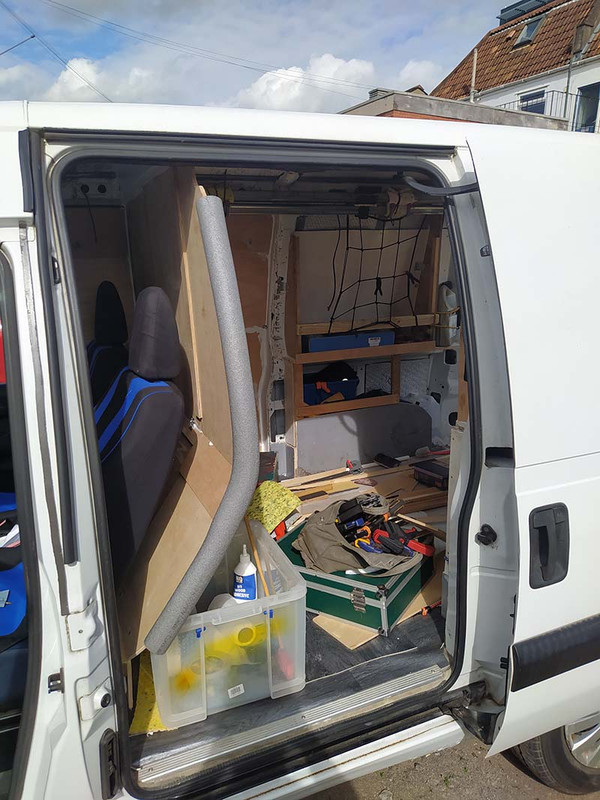
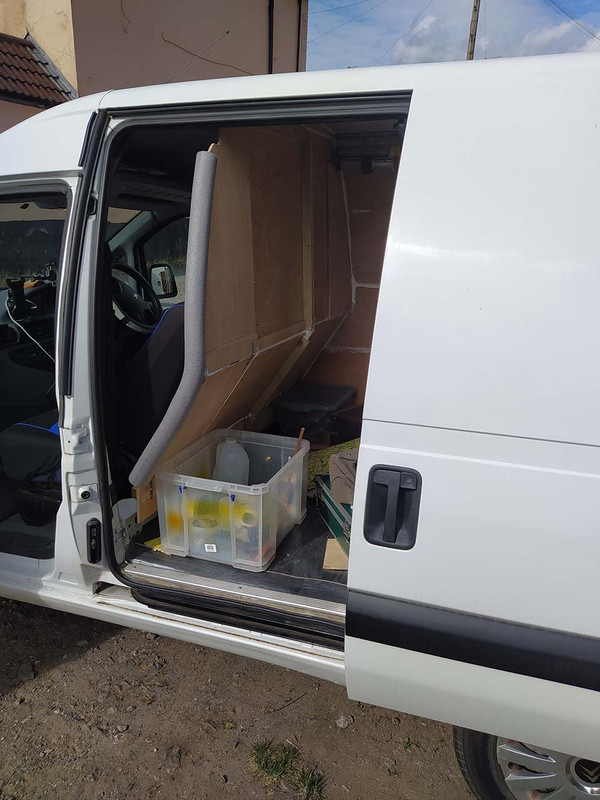
RH sliding door sealed up
deflectors fitted to doors
and partition done
Its so much quieter to drive now
Daily driving about the town it's very nice but it was at motorway speeds it got really unpleasant so I took it on my 'private test track' at speeds up to 90 and it was so much nicer to drive.
At 70 its not much different than my old Galaxy
that'll do me
Hopefully that's the last of the bigger jobs done and I can do all the tarting and tittivating and gadgets as and when
The roof rack has been disassembled and is now stowed up under the rh side roof/wall
and the fittings serviced and boxed up for when/if I need it.
#286 Re: Camper Conversions » SPLIT CHARGE RELAY FOR LEISURE BATTERY » 2024-06-30 21:43:24
Look on the bottom and you should see numbers next to the terminals
30/85/86/87 for instance
This will tell you what sort of relay it is.
4 pin is usually a make/break type, 5 pin usually a changeover with NO and NC terminals
The power rating you choose be above expected load
#287 Re: Maintenance » Speedo, Odometer & trip Meter Stopped Working. » 2024-06-28 16:40:22
I'd be careful about sticking your finger in a hole where it may get trapped in gears.
I'd lift the nearest wheel and use a mirror/torch sort of thing to see if the gear turns whilst the wheel is
being turned.
I'm still not convinced the sender drive shaft is supposed to be friction driven.
Never seen that and even if it was true it would prone to all sorts of potential errors and faults.
#288 Re: Maintenance » Speedo, Odometer & trip Meter Stopped Working. » 2024-06-25 17:23:37
It seem an awful expenditure of time and money renting a ramp
in Cheltenham.
If its the Alstone lane place, that's 40 miles from me in Fishponds
so 2 hours of driving and 2 gallons of deisel plus ramp rental
I'd just get my guy around the corner to do it and it would cost
me £40 for an hours labour.
#289 Re: Maintenance » Speedo, Odometer & trip Meter Stopped Working. » 2024-06-25 16:54:51
Magnetic induction/hall effect probably
yeah, but no, I dont buy that.
Possible, but my moneys on PSA using a cheap, tried and tested device
they have warehouses full of that eventually fell apart after 20 years of use
Why go to the cost of developing a unique, more costly and complex device?
#290 Re: Maintenance » Speedo, Odometer & trip Meter Stopped Working. » 2024-06-25 16:00:42
FYI
this place sells a new shaft for 65 PLN or £12.76
#291 Re: Maintenance » Speedo, Odometer & trip Meter Stopped Working. » 2024-06-25 15:53:23
I know this is a massive ballache for you
having what should be a simple job made such a PITA
But I'm still wondering what drives/drove the pulser?
your shaft has no inner plastic looking insert as per my previous pic and your sender doesn't seem to have a square drive
so how did it work?
I'll hazard some guesses:
The insert broke away and is stuck inside the pulser thereby concealing it
or bits fell off as it was removed?
You may need a new shaft as well if this the case but I'd rebuild it with epoxy
cos I'm a cheap bastard and hate to spend when I can fix it myself
It may be my imagination but there seems to be an echo of a square in the pic of the end your shaft
is that original material or gunk stuck in there?
try picking it out and see what you find
#292 Re: Maintenance » Speedo, Odometer & trip Meter Stopped Working. » 2024-06-25 12:46:09
Quote:
"I'm thinking it's not the clocks that are at fault. This is because at the same time as the speedo, odometer and trip stopped working, I started getting slight rough running/hesitancy in lower gears at lower speeds. Also I think my MPG dropped. This leads me to think that the ECU isn't getting the correct info to run engine properly."
That sounds quite plausible to me, why else take a feed off the speedo cable?
I'll try and find out what pin/cable colour is use on the engine management unit as that would probably be easier to access
did you swap over sender units?
#293 Maintenance » No more door » 2024-06-24 00:21:53
- RegW
- Replies: 3
I was umming and awwing over whether I needed or wanted an OS sliding door and decided to seal it up for better use of space in the van.
being 6'2" I also wanted to have the seat fully back for comfort as well
but not impinge on floor space
so decided to put some of the ply pieces laying about to good use.
I bought two cans of Sikaflex and used one sealing the door up outside and in
the other I used to (mainly) fit the ply along with some dowelling and screws
The top panel also has two bolts 'pinching' the door in to provide mechanical
back up the Sikaflex.
Sikaflex sticks like poop to a blanket and when set is still somewhat flexible
so hopefully it will help dampen vibrations and resonance.
I decided to make the partition behind the drivers seat a permanent fixture
The other I haven't decided on yet.
I've used up most of the ply now and will pause this particular project for now
and continue as and when I decide, but will finish the drivers side first.


#294 Re: Maintenance » Speedo, Odometer & trip Meter Stopped Working. » 2024-06-23 23:35:41
One quick test that comes to mind if the speedo packed in
would be to whip the clocks out
( I'm surprised how easily mine came out)
and monitor pin 9
I often use an led with a 1K series resistor to check for 12v or low voltages
I can patch it between a connector/pin and ground then drive/ride with both hands
free whilst just a glance at the led tells me if a circuit is working or not.
I've used it to check things like if a thermo rad switch was activating on a bike
or not
If the led goes on/off the problem is in the clocks
if the led doesn't flash the problem is in the wiring or sender
It seems better/quicker way to get to a fault than grovelling around under the van if you dont have to
#295 Re: Maintenance » Speedo, Odometer & trip Meter Stopped Working. » 2024-06-23 15:09:58
The signal out from the pulser goes to both the speedo and the engine management box
Here's some pics I've been extracting/converting and partially annotating from that sedre thing
note the engine type but 1620 is the sender unit in all


#296 Re: Maintenance » Speedo, Odometer & trip Meter Stopped Working. » 2024-06-23 14:53:37
It's worth checking you are getting power to the sender just in case
The 3 pin plug should have 12v at pin 1 and ground at pin 2
with signal out at pin 3
It will hard to check for signal out with out actually driving but ignition on
should show power at the plug.
My Peugeot wiring diagram shows it gets power from Fuse 4 in the passenger fuse box
I know they're all essentially the same but there are variations
I used the DW10 diagram
#297 Re: Maintenance » Speedo, Odometer & trip Meter Stopped Working. » 2024-06-22 14:02:08
The part number of 9600936680 gives the pic below and the green plastic bit at the tip suggests a square drive
socket perhaps?
a bit like motorcycle speedo drive
(this makes my keyway theory pretty much bollox  )
but there must be some mechanical means to drive a rotor past a sensor to create pulses
Going back in sounds frustrating but what else can you do?
take lotsa pics
£156 for new one? sod that, I'd test the sender on the bench and have it apart and I bet
there's a 3 pin 50p hall effect IC in there with maybe a couple of resistors

#298 Re: Maintenance » heater core decrap » 2024-06-22 12:18:45
Petrol? compressed air ? 
Way too risky for me that is
I understand petrol will dilute oil but there are safer options.
I didn't notice any oil anyway just years of slowly accumulated crud and crap
in the rusty looking soup
The heater seems to be working well at the moment but I have no criteria tell me
what to compare it to.
If I think it could be improved and with the coupler in place, I can easily use the same method again in the autumn
#299 Re: Maintenance » Speedo, Odometer & trip Meter Stopped Working. » 2024-06-22 11:52:14
Hmm ok,
I see 3 wires to the pulser so assuming pos, neg and signal
it probably is something like a hall effect or reluctor type affair
This still brings up the question how the pulser sitting on top of the device is driven
the one you have pictured has keyways so this suggests its designed to mate to a keyed shaft ( No1)
I understand it's sod to get to and with it probably being grubby and oily too
it would be easy to overlook the inner profile the new pulser has to mate to.
Relying on friction to drive it would be a very poor form.

Edit:
Maybe its my monitor but just looked to your first image more closely and
details looked washed out to me so darkened it in photoshop
I now see it does have keyways too, so maybe the square drive is not how it's driven
and were a distracting feature

#300 Re: Maintenance » Speedo, Odometer & trip Meter Stopped Working. » 2024-06-22 01:48:02
If your current sender doesn't have a square drive how does the gearbox drive the
pulser at the top of the sender?
Is it possible yours has broken off?
perhaps it broke off and dropped down into shaft (no1) in the drawing
and you didn't notice this due to age, oil, muck etc